
Dragons Across Cultures
There are many important differences between Eastern and Western dragons.

Whether you live in Cambodia or Scotland, Lithuania or America, you have probably heard of dragons. The eastern dragon, called lóng (older spelling lung) in China and rồng in Vietnam, may almost seem like a completely different creature than the Western Dragon. Their anatomy, their behavior, their symbolism, and what they mean to society are quite different. The East has tended to value dragons for their magic and beauty, and people there held them in high respect. In the West the view was very different: dragons were usually monsters.
This page surveys dragons region by region, then compares the two great traditions side by side. Follow the links for full articles on each culture.
Eastern and Western Dragons
Dragons from the East are used in ceremonies and parades. This creature, like the Western dragon, can sometimes also take on the form of a monster. However, it is made of many different animal qualities and parts. It symbolizes heroism and not so much danger or threat. The Eastern dragon is seen as more of a protector than a villain. It is a symbol of beauty and power. The Chinese even have a year of the dragon, and it is said that anyone born in this year will be healthy, wealthy, and wise, all of the things which the dragon of the East represents. The year of the dragon is also traditionally considered a prosperous year, and many families hope to have a child born in it.

Because the Chinese hold dragons in such great respect, there are many tales about dragons and the wealth that they bring to the people of China. One story is about a dragon's pearl. Many stories involve dragons protecting riches, but this story is about a single pearl. It is said that a poor boy, often named Nie Lang in retellings, found a dragon's pearl that multiplied everything that it touched. When he and his mother put it in their rice jar one night, the next morning it was full of rice. But when robbers came to steal the pearl, the young boy quickly swallowed it. The story goes that the boy then turned into a dragon himself.
While this Eastern story is about the good of turning into a magical dragon, the West has a story of punishment that leaves a man a dragon. In this story a prince kills his father for his fame and fortune. Because of this the dying king puts a curse on his son that he will become a dragon. Later in life this dragon is killed by another of his greedy brothers, who then receives the curse and becomes a dragon as well. Greed turning a person into a dragon is an old Northern European theme; the best-known example is Fafnir in the Norse Völsunga saga.
Very little seems to be the same between the dragons of the East and dragons of the West. Even the dragon's habitat changes between the two cultures. Eastern dragons almost all live in some sort of damp place, most likely a lake, a river, or the ocean. Western dragons are the ones said to be able to live in deserts, caves, or even in fire.
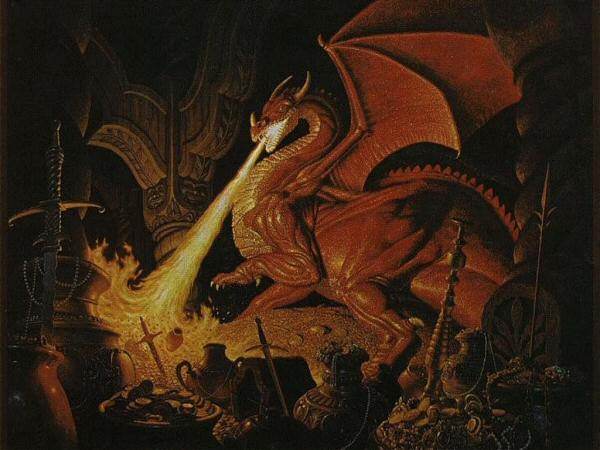
Dragons from the West are said to breathe fire and are seen as unwanted and something that a hero must work to get rid of. These dragons try to kill people who get near them by breathing out fire. They also have great wings and sharp claws.
A quick comparison
| Eastern dragon (China, Japan, Korea, Vietnam) | Western dragon (Europe) | |
|---|---|---|
| Body | Long and snakelike, four legs, usually no wings | Heavy, lizard- or serpent-like, often bat wings |
| Element | Water: rain, rivers, seas, clouds | Fire, caves, wastelands |
| Flight | Flies by magic, without wings | Flies with wings |
| Character | Wise, lucky, sometimes stern or moody | Greedy, destructive, a test for heroes |
| Treasure | A single flaming pearl | A hoard of gold |
| Symbol of | The emperor, good fortune, rain | Chaos, sin, or the Devil; later national pride |
East Asia
China
China has one of the oldest continuous dragon traditions in the world. Archaeologists have found a dragon-shaped mosaic of clam shells in a grave at Xishuipo in Henan province, about 6,000 years old, and C-shaped jade "pig dragons" from the Hongshan culture of the northeast. Over the following millennia the lóng became the bringer of rain, the guardian of rivers and seas, and finally the emblem of the emperor himself. Read more on our Chinese dragons page.
Japan
Japanese dragons, called ryū or tatsu, blend the Chinese model with older native water spirits. The sea god Ryūjin rules from an undersea palace and controls the tides with magic jewels. The most famous native monster is Yamata no Orochi, an eight-headed, eight-tailed serpent slain by the storm god Susanoo in the Kojiki (712 AD), the oldest surviving Japanese chronicle. You can read about it on our famous dragons page, along with legends such as Yofune-Nushi and Yorimasa the Dragon-Slayer. Japanese art usually shows dragons with three claws.
Korea
The Korean yong is a benevolent water and weather spirit much like its Chinese cousin. Korean folklore adds the imugi, a great serpent that must live a thousand years, or obtain a magic pearl, before it can become a true dragon. According to tradition, King Munmu of Silla asked to be buried at sea so that he could become a dragon and defend the kingdom from raiders.
Vietnam
The Vietnamese tell that their people descend from Lạc Long Quân, a dragon lord, and Âu Cơ, a mountain fairy. Their hundred children divided between the sea and the mountains, and the Vietnamese still sometimes call themselves "children of the dragon and grandchildren of the fairy." The rồng appears on palaces, temples, and in festival dances.
India and Southeast Asia
In India the great serpent beings are nagas: cobra-hooded spirits who guard waters and treasures, and who can take human form. In the Rigveda, the god Indra slays Vritra, a serpent or dragon who had hoarded the world's waters, and releases the rivers. In Buddhist legend the naga king Mucalinda coiled around the meditating Buddha and spread his hoods to shelter him from a storm. Buddhism and Hinduism carried the naga to Cambodia, Thailand, Laos, and Indonesia. At Angkor in Cambodia, many-headed naga balustrades line the causeways, and in Thailand and Laos naga staircases rise to temple doors.
The Ancient Near East and Persia
Some of the oldest dragon stories come from Mesopotamia. In the Babylonian creation epic Enuma Elish, the god Marduk defeats the primordial sea goddess Tiamat and builds heaven and earth from her body. Tiamat is often pictured today as a dragon, though the poem never describes her shape clearly. Babylonian art does show a true dragon: the mušḫuššu, a scaly beast with a serpent's head, lion's forelegs, and eagle's hind feet, which parades in glazed brick on the Ishtar Gate of Babylon.
In Egypt, the giant serpent Apep (Apophis) attacked the sun god Ra's boat every night and had to be beaten back before dawn. The Canaanite city of Ugarit had Lotan, a twisting sea serpent defeated by the storm god Baal, who is a close relative of the biblical Leviathan. See Dragons in the Bible for Leviathan, Rahab, and the great red dragon of Revelation.
Persian tradition has Azhi Dahaka, a three-headed dragon of the Zoroastrian Avesta. In Ferdowsi's epic Shahnameh he becomes Zahhak, a tyrant king with a snake growing from each shoulder.
Greece and Rome
The English word "dragon" comes through Latin draco from Greek drakōn, which originally meant any large serpent. Greek dragons were mostly enormous snakes that guarded sacred places: Python at Delphi, killed by Apollo; Ladon, who coiled around the tree of golden apples in the garden of the Hesperides; and the sleepless dragon of Colchis that guarded the Golden Fleece. The many-headed Hydra fought by Heracles belongs to the same family. The Romans inherited all of these and added military dragon banners of their own. See Roman Dragons.
Northern and Western Europe
Norse and Germanic lands
Norse myth has Jörmungandr, the World Serpent that circles the earth; Nidhogg, who gnaws the roots of the world tree; and Fafnir, slain by Sigurd. German folklore is full of Lindwürmer (lindworms), and the hero Siegfried of the Nibelungenlied bathed in a dragon's blood to make his skin invulnerable. Viking ships carried carved dragon heads on their prows. See German Dragons and the Scandinavian fairy tale The Bride of the Lindorm King.
Britain and Ireland
The Old English poem Beowulf ends with the hero's death fighting a treasure-guarding dragon. Wales took the red dragon as its national emblem after the legend of the red and white dragons of Dinas Emrys, told on our Welsh Dragons page. English villages have their local "worms," such as the Lambton Worm and the Laidly Worm of Spindleston Heugh (Childe Wynde). England's patron saint is a dragon-slayer: Saint George. For Irish and Scottish traditions, see Dragons in Celtic Mythology.
France and Spain
France has the Tarasque of Tarascon, tamed by Saint Martha, and the Vouivre, a winged serpent with a gemstone eye. In Asturias in northern Spain, the Cuélebre is a winged serpent that guards treasure and enchanted maidens in caves.
Eastern Europe
Slavic folklore has the zmey (Russian zmei, Polish żmij), often many-headed. In Russian tales, Zmey Gorynych is a three-headed dragon defeated by the hero Dobrynya Nikitich. Poland's most famous dragon is the Wawel Dragon of Kraków; read The Legend of Krakus and Smok. Lithuanian folklore gives us Eglė the Queen of Serpents, who marries a serpent king, and the žaltys, a harmless grass snake kept as a household guardian. Balkan and Romanian folklore has the zmeu and the balaur, a many-headed dragon. Other Eastern European tales on this site include The Gypsy and the Dragon and The Peasant and the Dragon.
The Americas
Mesoamerica's great serpent deity is Quetzalcoatl, the "feathered serpent" of the Aztecs, known to the Maya as Kukulkan. The Aztecs also had Xiuhcoatl, the fire serpent wielded by the war god Huitzilopochtli. Further north, many Native American peoples tell of horned water serpents, and the Great Lakes region has the Mishipeshu, a horned underwater panther. These creatures were not borrowed from Europe or Asia, which is one reason scholars find dragons so interesting.
Africa and Oceania
In the mythology of the Fon of Benin, the rainbow serpent Aido-Hwedo carried the creator through the world as it was being made, and now lies coiled beneath the earth holding it up. Across much of Aboriginal Australia, the Rainbow Serpent is a powerful creator being linked to water holes, rain, and the shaping of the land. Stories differ widely from one people to another, and many are sacred and not meant to be retold casually.
Why Are Dragons Everywhere?
In almost everything we read about dragons, the author has had to decide which type of dragon to focus on, the Eastern or the Western. This usually depends on where the author is from and so the type of dragon that he or she is most accustomed to. When talking about dragons it can almost be impossible to talk about a dragon without being biased to one culture or the other.
It could be that the reason each dragon is different between cultures is because the people had never actually seen one, only heard stories and descriptions of them.
Scholars have offered several explanations for why so many separate cultures imagined something dragon-like. The anthropologist David E. Jones, in An Instinct for Dragons, argued that the dragon combines the three predators our primate ancestors feared most: snakes, big cats, and birds of prey. The historian Adrienne Mayor has shown that ancient Greeks and others found huge fossil bones and interpreted them as the remains of monsters. Others point to real animals such as crocodiles, pythons, and monitor lizards, or to the way a serpent naturally stands for water, which can bring life as rain or death as flood. No single theory explains every dragon, and the history of dragons is a story of ideas traveling, mixing, and changing.
Frequently Asked Questions
What is the main difference between Eastern and Western dragons?
Eastern dragons are long, wingless, water-loving creatures associated with rain, wisdom, and good fortune. Western dragons are usually winged, fire-breathing monsters that hoard treasure and are defeated by heroes.
Which culture has the oldest dragons?
China's dragon images go back about 6,000 years, and Mesopotamian dragon-like creatures appear in art and writing from the third millennium BC. Both traditions are far older than the European dragon stories most people know.
Do any cultures have good Western-style dragons?
Wales is the clearest example: its red dragon is a proud national symbol. In heraldry, too, a dragon on a coat of arms usually stands for strength and courage rather than evil.
Are nagas and feathered serpents really dragons?
Not exactly. They are great serpent beings in their own traditions, but they fill many of the same roles as dragons, such as guarding water and treasure, and they are often grouped with dragons in studies of mythology.
For a closer look at the many kinds of dragons, see Dragon Types and What is a Dragon?
Sources and Further Reading
- Enūma Eliš (The Epic of Creation) and Anzû, in Stephanie Dalley, trans., Myths from Mesopotamia: Creation, the Flood, Gilgamesh, and Others (Oxford University Press, 1989).
- Michael D. Coogan and Mark S. Smith, eds. and trans., Stories from Ancient Canaan, 2nd ed. (Westminster John Knox Press, 2012).
- The Rig Veda: An Anthology, trans. Wendy Doniger O'Flaherty (Penguin Classics, 1981).
- Abolqasem Ferdowsi, Shahnameh: The Persian Book of Kings, trans. Dick Davis (Viking, 2006).
- Kojiki, trans. Donald L. Philippi (University of Tokyo Press, 1968).
- Beowulf, trans. Seamus Heaney (Farrar, Straus and Giroux, 2000).
- The Saga of the Volsungs, trans. Jesse L. Byock (Penguin Classics, 1999).
- The Nibelungenlied, trans. A. T. Hatto (Penguin Classics, 1965).
- David E. Jones, An Instinct for Dragons (Routledge, 2000).
- Adrienne Mayor, The First Fossil Hunters: Paleontology in Greek and Roman Times (Princeton University Press, 2000).