
Dragon Types
Myth sorts dragons by body shape and homeland. Modern fantasy usually sorts them by color.
There are many different types of dragons. From cruel and vile to cunning and majestic, dragons have inspired, or terrorized, many throughout history. All are a force to be reckoned with. Two of the main kinds of dragons in modern fantasy are metallic dragons, which are good, and chromatic dragons, which are evil. This article will describe different kinds of chromatic dragons—black dragons, red dragons, blue dragons, green dragons, and white dragons. You may also be interested in wyverns, which are dragon-like creatures, and our complete list of dragon species.
Before the color dragons, though, it helps to know the older ways of telling dragons apart. Folklore, heraldry, and art have their own vocabulary for dragons, built mostly on how many legs and wings a creature has and where it comes from. That vocabulary is covered first below, followed by the color types of modern fantasy games.
How Dragons Are Classified
No ancient writer set out to build a complete catalog of dragon types. The categories people use today grew up over time from several sources: Greek and Roman natural history, medieval bestiaries, the rules of heraldry, Chinese and Japanese art, and, since the 1970s, fantasy role-playing games.
In European tradition, the main things that set one type apart from another are the number of legs, whether the creature has wings, and whether it lives on land or in water. In East Asian tradition, the differences are more about rank and role: what a dragon governs, how many claws it shows, and whether it has finished growing into its full power. In modern fantasy, the deciding feature is usually color, which tells you a dragon's breath weapon, home terrain, and personality at a glance.
None of these systems is "official," and older writers often used the words loosely. The Old English poem Beowulf calls its fire-breathing monster both a draca (dragon) and a wyrm (serpent) without drawing any distinction between them.
Dragon Types in Myth and Legend
The Western dragon
The classic Western dragon has four legs, a pair of bat-like wings, a long neck and tail, scales, and often horns. It breathes fire or poison, hoards treasure, and lives in a cave or lair. This six-limbed body plan became standard in European art during the late Middle Ages and Renaissance. Earlier European dragons were often more serpent-like, and the Greek word drakon could mean simply a huge snake.
The wyvern
A wyvern has two legs and two wings, with the wings doing the work that the front legs do on a four-legged dragon. In English heraldry the distinction is strict: a "dragon" has four legs and a "wyvern" has two. Outside heraldry, many medieval artists drew two-legged dragons without calling them anything special, and modern films and games now often show dragons with the wyvern's body plan.
The lindworm
The lindworm (also lindwurm or lindorm) belongs to Scandinavian and German folklore. It is a huge serpent, usually wingless, with either two front legs or no legs at all. Lindworms appear on Swedish rune stones and in fairy tales such as The Bride of the Lindorm King. The city of Klagenfurt in Austria uses a lindworm as its emblem, and a large stone lindworm fountain stands in its main square.
The amphiptere
An amphiptere is a winged serpent with no legs at all. The name comes from Greek roots meaning "wings on both sides." Winged serpents turn up in the Greek historian Herodotus, who reported that they guarded frankincense trees in Arabia, and in later European bestiaries. In heraldry, the amphiptere is a rare charge, much less common than the dragon or wyvern.
The drake and the wyrm
"Drake" is an old English word for dragon, coming from the same Latin draco that gave us "dragon." In modern fantasy it often means a smaller, less intelligent, or wingless dragon, but that is a recent convention, not an ancient one. J.R.R. Tolkien used "fire-drake" and "cold-drake" for different kinds of dragons in Middle-earth.
"Wyrm" is the Old English word for serpent or worm, and many English legends call their dragons worms: the Lambton Worm, the Sockburn Worm, and the Laidly Worm of Spindleston Heugh (the story behind Childe Wynde). These are usually long, limbless or nearly limbless creatures that coil around hills and devour livestock.
Sea serpents and sea dragons
Water dragons are among the oldest dragons of all. The Bible's Leviathan is a monster of the sea, and the Norse Midgard Serpent, Jörmungandr, lies coiled around the world in the ocean. Sailors' tales of sea serpents lasted well into the 1800s. Many river and lake dragons of folklore, such as the Welsh afanc or English "knuckers," also belong to this watery family.
The Chinese lung
The Chinese dragon, or lóng (also spelled lung), is a long, snake-like creature with four legs, scales, whiskers, and antler-like horns. It usually has no wings and flies by its own power. Instead of being a monster to be slain, it is a wise and powerful bringer of rain and a symbol of the emperor. Chinese tradition recognizes many kinds of dragons, such as the winged yinglong, and later writers listed nine "sons" of the dragon, each with its own personality.
A well-known later description says the dragon combines parts of nine animals: the head of a camel, horns of a stag, eyes of a demon, ears of a cow, neck of a snake, belly of a clam, scales of a carp, claws of an eagle, and soles of a tiger.
The Japanese ryū
Japanese dragons, called ryū or tatsu, were shaped by Chinese art and Buddhism but also draw on older native water spirits. They are usually linked to the sea, rivers, and rain. The dragon king Ryūjin rules the ocean from an underwater palace, as in the tale A Stay at the Waters Kingdom. Japanese art often shows dragons with three claws, while Chinese imperial dragons have five. Japan also has its own monstrous serpents, such as the eight-headed Yamata no Orochi and the sea monster in The Legend of Yofune-Nushi.
Feathered serpents and other kinds
In Mesoamerica, the feathered serpent Quetzalcoatl was a creator god, and the Aztec fire serpent Xiuhcóatl was a weapon of the gods. Greek myth gives us many-headed dragons like the Hydra and the fire-breathing chimera, which is part lion and part goat as well as part serpent. Smaller cousins of the dragon include the basilisk and the cockatrice, whose glance or breath could kill.
Dragon, Wyvern, Lindworm, Amphiptere, Drake: A Quick Comparison
| Type | Legs | Wings | Main tradition |
|---|---|---|---|
| Western dragon | 4 | Yes | European legend and heraldry |
| Wyvern | 2 | Yes | English heraldry, medieval art |
| Lindworm | 0 or 2 | Usually no | Scandinavian and German folklore |
| Amphiptere | 0 | Yes | Heraldry, bestiaries |
| Wyrm or worm | Usually 0 | Usually no | English and Norse legend |
| Drake | Varies | Varies | Old English word; modern fantasy |
| Chinese lung | 4 | Usually no | China, East Asia |
| Japanese ryū | 4 | No | Japan |
The Chromatic Dragons of Fantasy Games
Sorting dragons by color is a modern idea. It comes mostly from Dungeons & Dragons, first published in 1974, which gave each color of dragon its own breath weapon, home terrain, and personality. Chromatic dragons are the evil family, and their queen is the five-headed goddess Tiamat, who borrows her name from the Babylonian Tiamat. Their good counterparts are the metallic dragons: brass, bronze, copper, gold, and silver.
The five chromatic types below have kept the same basic traits through every edition of the game, and they have influenced countless video games, novels, and miniatures since. Other games and books use their own systems, so treat these descriptions as D&D-style fantasy, not ancient legend.
Black Dragons

Black dragons are vile, evil tempered, and obsessed with death. They live in fetid, swampy habitats. They find comfort in the sickening-sweet aroma of drowned, rotting carcasses. The black dragon's domain is the swamp and the jungle. They are abusive, quick to anger, and malevolent. Their hearts are as black as their slimy scales.
A black dragon can be identified by his grim, skeletal appearance. His eyes lie in deep sockets. His two great horns curve forward and down. The flesh of his face appears to have partially deteriorated, as if burnt by acid. Acidic slime drools from his menacing grin. He smells of rotting vegetation, foul water, and poisonous acid.
Living in sticky, wet habitats, black dragons dine mostly on fish, eels, and other water creatures. They will eat meat, but prefer to let their victims float in ponds for days, or even weeks, before eating them.
If you ever encounter a black dragon, be careful—he prefers surprise attacks instead of fair fighting. He is most active in the darkest hour of night, when the darkness makes him feel confident and powerful. He breathes a poisonous, sizzling acid.
Red Dragons

Red dragons are greedy and covetous, and obsessed with increasing their treasure hoards. They live in warm habitats, such as volcanoes or tropical islands. The red dragon's domain is the mountain and the island. They are vain, cunning, and terrible. They are the largest and most powerful of the chromatic dragons, and the classic image of the fire-breathing, gold-hoarding dragon.
A red dragon can be identified by his long wings and two long horns. He has a long, red, forked tongue. Tiny flames often dance in his nostrils when he is angry. His eyes gleam with unrestrained greed when he has seen treasure. He smells of smoke and sulfur.
Red dragons are fiercely territorial. They prefer to eat meat, especially people. Red dragons have been known to force villages to sacrifice maidens to them. (This is a matter of taste. As you would have it, apparently maidens "just taste better.") The best part of a meal for a red dragon is drinking the blood.
Red dragons breathe a deadly fire.
Blue Dragons

Blue dragons are pensive, lawful, and vain. They live in hot, dry areas, such as sandy deserts or arid steppes.
A blue dragon can be identified by his frilled ears and a single horn upon his head. His eyes are smooth, glossy, and without pupils; when looking at them, you may feel as though you are looking into eternity. The dry scent of ozone and sand follows a blue dragon wherever he goes. The blue dragon is large and vibrant.
He loves to soar in the hot desert air. He is a dedicated carnivore who will eat snakes, lizards, and occasionally even desert plants, but truly prefers herd animals such as camels. Blue dragons are a real threat to caravans crossing the desert. He prefers to attack people in ambush. Surprise and distance are his greatest allies, and he is good at tracking.
Blue dragons enjoy sitting and reflecting. The blue dragon is blue-blooded (that is to say, cold, effete, or noble). He is lawful and has some sense of morals.
Blue dragons breathe lightning, that is, a lightning bolt.
Green Dragons
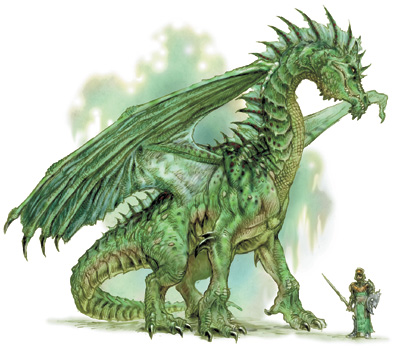
The green dragon is a belligerent creature and master of intrigue, politics, and backbiting. He is cruel. He prefers forests—the older and bigger the trees, the better. Instead of being overtly aggressive, he prefers to concoct elaborate schemes to gain power or wealth with as little effort as possible. He may make his lair behind a waterfall or near a lake, pond, or stream that provides a submerged entrance. The closer one gets to his lair, the darker the woods become. Evil hangs in the air, mingling with the forest scents to produce foul odors.
The green dragon's head is covered in hornlets. He has a long neck and legs, and resembles a brontosaurus. The green dragon reeks of chlorine.
The green dragon is a liar and master of verbal evasion. Just talking to a green dragon can lead to ruin. When attacking, he will usually stalk his prey first, sometimes for days, and he is good at tracking. The green dragon has a palate for elf flesh. He loves to play with his prey. He will subsist on practically anything, including shrubs and small trees. He uses camouflage to his advantage. He is obsessed with life and growth, and wants to live eternally. He is envious.
The green dragon likes to instill terror in lesser opponents before torturing them to death.
Green dragons breathe poisonous gas, that is, a toxic chlorine gas.
White Dragons

White dragons are the smallest of the chromatic dragons, and the least clever, though they have very good memories. They live in frigid, icy climates — usually arctic areas, but sometimes very high mountains. They travel alone. They prefer the solitude of snowy plains and caves, far away from the warming rays of the sun.
A white dragon can be identified by his sharp eyes and intense expression. His scales resemble fur, or even feathers, in places. His wide feet and sharp claws help him to walk atop snowbanks. An aura of coldness seems to emanate from the white dragon.
Living in frosty climes, white dragons prefer their food to be suitably chilled. If their victims have not frozen to death already, white dragons will often pack them away in the snow until they are properly frozen.
If you ever encounter a white dragon, be on your guard— he is swift and alert. Your best bet is to scare or intimidate him, as white dragons are sometimes known to be cowardly. He breathes a chilling frost.
Chromatic Dragons at a Glance
| Color | Breath | Home | Personality |
|---|---|---|---|
| Black | Acid | Swamps and jungles | Cruel, ambushing, obsessed with death |
| Blue | Lightning | Deserts and dry plains | Vain, orderly, territorial |
| Green | Poison gas | Old forests | Scheming liars |
| Red | Fire | Mountains and volcanoes | Greedy, proud, the most powerful |
| White | Cold | Arctic and high peaks | Savage, solitary, animal-like |
Other Dragon Types in Modern Fantasy
Dungeons & Dragons has added many more families over the decades. Besides the chromatic and metallic dragons, there are gem dragons (amethyst, crystal, emerald, sapphire, and topaz), which were given a fresh treatment in Fizban's Treasury of Dragons in 2021, along with planar, undead, and elemental varieties. You can find more on using them at the table in our tips for using dragons in fantasy RPGs.
Novelists have built their own systems too. Tolkien's Middle-earth has fire-drakes, cold-drakes, and winged dragons such as Smaug and Ancalagon the Black. Anne McCaffrey's Pern books (starting with Dragonriders of Pern) sort dragons by color into a ranked society, with gold queens at the top. Video games like The Elder Scrolls V: Skyrim use the wyvern body plan for their dragons. Each of these is a modern invention, built on top of the older folklore types described above.
Frequently Asked Questions
How many types of dragons are there?
There is no fixed number. Folklore and heraldry use a handful of body types (dragon, wyvern, lindworm, amphiptere, wyrm), while individual cultures name dozens of specific kinds. Our dragon species page lists many of them.
What is the difference between a dragon and a wyvern?
In heraldry, a dragon has four legs and two wings, while a wyvern has only two legs and two wings. Outside heraldry the words are often used loosely.
What are the five chromatic dragons?
In Dungeons & Dragons, the five chromatic dragons are black, blue, green, red, and white. They are usually evil and serve the dragon goddess Tiamat.
Do Chinese dragons have wings?
Most do not. Chinese dragons fly by their own magical power. The yinglong is a notable exception and is usually shown with wings.
Is a lindworm a dragon?
Yes. A lindworm is a serpent-like dragon from Scandinavian and German folklore, usually wingless and with two legs or none.
Sources and Further Reading
- Herodotus, The Histories, trans. Robin Waterfield (Oxford World's Classics, 1998).
- Beowulf, trans. Seamus Heaney (Farrar, Straus and Giroux, 2000).
- Monster Manual (Wizards of the Coast, 2014).
- Fizban's Treasury of Dragons (Wizards of the Coast, 2021).
- Arthur Charles Fox-Davies, A Complete Guide to Heraldry (T. C. & E. C. Jack, 1909).
- John Vinycomb, Fictitious and Symbolic Creatures in Art, with Special Reference to Their Use in British Heraldry (Chapman & Hall, 1906).
- Jacqueline Simpson, British Dragons (Batsford, 1980).
- M. W. de Visser, The Dragon in China and Japan (Johannes Müller, 1913).