
Metallic Dragons
Metallic dragons in modern fantasy are good, unlike chromatic dragons.
All dragons have the choice whether to be good or evil. But there are some general tendencies based on type. Unlike chromatic dragons, which are usually evil, metallic dragons are usually good. There are five kinds of metallic dragons: brass, bronze, copper, gold, and silver.
Metallic dragons are an invention of Dungeons & Dragons, the role-playing game first published in 1974. They have no direct ancestor in ancient myth, where dragons in the West were almost always monsters. In their wisdom and kindness, though, they owe something to the benevolent dragons of China and Japan, and the gold dragon's catfish-like whiskers are a clear nod to the Chinese dragon. This page describes them in general terms, as they have appeared across the game's editions.
What Are Metallic Dragons?
In D&D, true dragons are divided into families, and the two oldest are the chromatic dragons (black, blue, green, red, and white) and the metallic dragons (brass, bronze, copper, gold, and silver). Chromatic dragons are typically greedy and cruel. Metallic dragons are typically good, curious about the world, and willing to help other creatures, though they can be just as proud and protective of their treasure as their evil cousins.
Like other true dragons, metallics hatch from eggs and grow throughout their long lives, from small wyrmlings to enormous ancient dragons that can live for well over a thousand years. Their scales are dull when they hatch and grow brighter and more metallic with age. In most editions, every metallic dragon has two breath weapons: a damaging one, such as fire or lightning, and a second one that disables without harming, such as a sleep gas or a paralyzing gas. Many of them can also take the shape of humans or other creatures, which lets them live among people unnoticed.
Brass Dragons
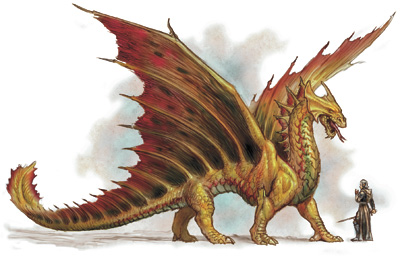
These are the most gregarious of all dragons, and are famous for their love of conversation. They crave sunlight and dry heat, so they frequent hot, arid regions, particularly sandy deserts. They like to make their lairs in high, rocky caves.
Brass dragons have dull, mottled brown scales at birth. As time goes on, the scales become more brassy until they reach a warm, burnished appearance. Brass dragons have supple, expressive lips. These are very useful, as they like to do lots of talking. They can breathe fire, and also a gas that puts creatures to sleep.
A brass dragon who meets a traveler is more likely to start a long chat than a fight, and may use its sleep gas on someone who tries to leave before the conversation is over. Brass dragons share their desert homes with blue dragons, and the two are bitter rivals.
Bronze Dragons
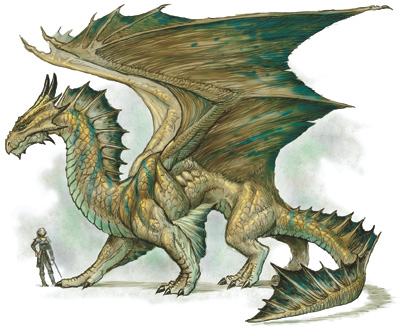
Having a strong sense of justice, bronze dragons do not tolerate cruelty or anarchy in any form. They are also inquisitive and find humanoids fascinating. They live near deep water, especially in tropical coastal areas and islands. They wage a constant struggle against evil sea creatures, and often live in caves or near underground streams or lakes.
Bronze dragons have a beaklike snout and a pointed tongue. Their feet are webbed and they have webbing behind their forelimbs. Their scales are smooth and flat.
Bronze dragons breathe lightning and a gas that pushes creatures away. They are strong swimmers and often watch over shipping lanes. Because they are drawn to fighting evil, bronze dragons sometimes take human form to help fight for a cause they believe in.
Copper Dragons

These have a well-deserved reputation as incorrigible pranksters, joke-tellers, and riddlers. They live in dry, rocky uplands and mountains. They live in narrow caves.
Copper dragons have massive thighs and shoulders, as they are excellent jumpers and climbers. Like other metallic dragons, their scales are dull at birth and become shinier with aging. They love sharing jokes and will eat almost anything.
Copper dragons breathe acid and a gas that slows creatures down. They fill their lairs with mazes, false passages, and traps meant to fool visitors rather than kill them. A copper dragon will often respect anyone who can tell it a joke or riddle it hasn't heard before.
Gold Dragons

Gold dragons are champions against evil and foul play. They often embark on self-appointed quests to promote good. They make their lairs in secluded areas, such as deep gorges or high plateaus.
Gold dragons have large, twin horns that are smooth and metallic, and whiskers around the mouth like a catfish. A gold dragon smells of saffron and incense.
Gold dragons are the most powerful of the metallic dragons, just as red dragons are the most powerful of the chromatics. They breathe fire and a gas that saps strength. They are wise, patient, and slow to anger, and they often travel in disguise as humans or animals to keep watch on the world.
Silver Dragons
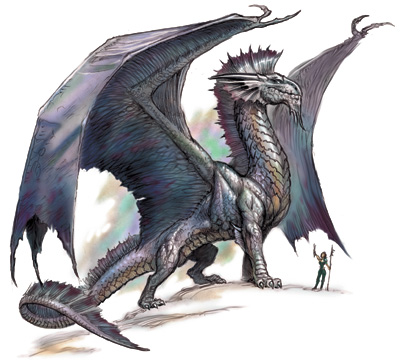
These dragons enjoy helping the meek and the lowly. They often concern themselves with protecting the innocent and healing their injuries. They love high mountains and vast, open skies with billowing clouds. They enjoy flying and sometimes soar for hours just for the pleasure of it.
A silver dragon has a beaklike nose, a strong chin, and a pointed tongue. They are nonviolent and avoid combat whenever possible. They are the most sensitive of all dragons.
Silver dragons breathe a freezing cold and a gas that paralyzes. Of all the dragons, they are the most fond of people, and they often spend years in human or elf form, making close friends among them. Their natural enemies are red dragons, which compete with them for mountain territory.
Metallic Dragons at a Glance
| Dragon | Breath weapons | Typical home | Personality |
|---|---|---|---|
| Brass | Fire, sleep gas | Deserts | Talkative, sociable |
| Bronze | Lightning, repelling gas | Coasts and islands | Just, curious, warlike against evil |
| Copper | Acid, slowing gas | Rocky hills | Pranksters and riddlers |
| Gold | Fire, weakening gas | Secluded gorges and plateaus | Wise, noble, the most powerful |
| Silver | Cold, paralyzing gas | Mountain peaks and clouds | Kind, protective, fond of people |
Metallic vs. Chromatic Dragons
The two families mirror each other. Each chromatic dragon has a metallic counterpart that shares something with it, whether a breath weapon, a home terrain, or both. Brass and blue dragons both live in deserts. Silver and red dragons both claim the high mountains. Gold and red dragons both breathe fire and are the strongest of their families.
The biggest difference is in temperament. Chromatic dragons see other creatures as prey, servants, or threats. Metallic dragons see them as neighbors, and sometimes as friends. Chromatics hoard treasure out of greed. Metallics also keep hoards, but they are more likely to value art, books, or objects with a story behind them. Chromatics usually want to rule; metallics usually want to be left alone, or to protect someone.
Metallic dragons also have a second breath weapon designed to stop a fight rather than win it. That gives the game a way to show that these dragons would rather not kill. A party that wanders into a metallic dragon's lair is more likely to be put to sleep or slowed down than burned alive.
Life Cycle, Lairs, and Hoards
A metallic dragon's life follows the same path as any true dragon's in the game. It hatches small enough to hold in your arms, grows quickly through its youth, and keeps growing for centuries. The oldest metallic dragons are among the most powerful creatures in any D&D world. As they age, their scales shift from the dull, mottled colors of youth toward the bright sheen of the metal they are named for, and their personalities usually soften from youthful impatience into patience and wisdom.
Metallic dragons choose lairs that fit their temperament. Brass dragons favor sandy caves and rock spires where they can bask in the heat. Bronze dragons build in coastal sea caves, often with entrances hidden below the waterline. Copper dragons pick twisting caverns in the hills that suit their love of tricks. Gold dragons seek out hidden, hard-to-reach places such as waterfalls and lonely plateaus. Silver dragons nest on remote mountaintops, and in some settings even make homes in the clouds.
Like all dragons, metallics keep treasure, and an old dragon's hoard can be enormous. In general, though, they collect with more taste than greed, and a good dragon may guard a treasure because it is beautiful or important rather than simply valuable. Stealing from any dragon is still a very bad idea.
Bahamut, the Platinum Dragon
The metallic dragons look to Bahamut, the Platinum Dragon, as their king and god. He is lawful good, the sworn enemy of Tiamat, the five-headed queen of the chromatic dragons. In his true form he is a huge, shining dragon with platinum scales. He often wanders the world disguised as an old man, traditionally accompanied by seven canaries that are really gold dragons in disguise.
Bahamut's name comes from Arabic legend, where Bahamut is a gigantic fish that holds up the world, not a dragon. His opposite, Tiamat, takes her name from the Babylonian goddess Tiamat, the chaos monster slain by the god Marduk. D&D borrowed both names and turned them into a pair of rival dragon gods.
Metallic Dragons Through the Editions
The original 1974 rules included only one good-aligned dragon, the golden dragon, alongside the five evil colors. The Greyhawk supplement (1975) added brass, bronze, copper, and silver dragons, along with the Platinum Dragon and the Chromatic Dragon, and the first Advanced Dungeons & Dragons Monster Manual (1977) named those two Bahamut and Tiamat.
The Dragonlance setting, launched in 1984, made good dragons central to its story. In its world of Krynn, the good dragons have been missing for centuries, and their return helps turn the tide of a great war. Silver dragons play a large part in that setting, both in the legend of the knight Huma and in the novels.
The third edition (2000) kept a detailed ladder of twelve age categories, now running from wyrmling to great wyrm, and fleshed out each kind's appearance and habits. The fourth edition (2008) shuffled the lineup, bringing in new metallic dragons such as adamantine and iron and presenting metallic dragons as less uniformly good. The fifth edition (2014) returned to the classic five metallics, all of them good. Supplements over the years have added other metals, such as steel and mithral, and Fizban's Treasury of Dragons (2021) expanded the lore of dragons in general, including their gem dragon cousins.
Metallic dragons have also appeared in many D&D computer games and as miniatures. If you want to bring one into your own campaign, see our tips for using dragons in fantasy RPGs, or try the fantasy name generator for a dragon's name.
Frequently Asked Questions
Are metallic dragons always good?
Usually, but not always. The rules describe them as typically good, and individual dragons can be selfish, proud, or even evil. Some editions loosened the link between color and alignment further.
Which metallic dragon is the strongest?
The gold dragon is the most powerful of the five classic metallic dragons. Silver dragons come second.
Who is the god of the metallic dragons?
Bahamut, the Platinum Dragon, is the king of good dragons and the rival of Tiamat, queen of the evil chromatic dragons.
Are metallic dragons found in real mythology?
No. Metallic dragons were created for Dungeons & Dragons. Real-world myths have good dragons, especially in East Asia, but they are not sorted by metal.
Sources and Further Reading
- Gary Gygax and Dave Arneson, Dungeons & Dragons (TSR, 1974).
- Gary Gygax and Robert Kuntz, Supplement I: Greyhawk (TSR, 1975).
- Gary Gygax, Advanced Dungeons & Dragons Monster Manual (TSR, 1977).
- Bill Slavicsek, Draconomicon (TSR, 1990).
- Monster Manual (Wizards of the Coast, 2014).
- Fizban's Treasury of Dragons (Wizards of the Coast, 2021).