
Basilisk
The Basilisk is a terrible monster who can turn people to stone with its gaze.
The manner in which a basilisk is truly born is a matter of debate. The earliest accounts of the creature say nothing about its birth at all; the story that a basilisk is hatched by a cockerel from the egg of a serpent or toad grew up later, in the Middle Ages. As the legend of the basilisk spread, it was added that the egg had to be round and yolkless, it had to be laid under Sirius (the Dog Star), and the rooster that hatched it had to be seven years old. Though similar, it is not to be confused with a cockatrice that was hatched by a serpent or toad from the egg of a cockerel.
The name comes from the Greek basiliskos, meaning "little king." Latin writers sometimes called it regulus, which means the same thing. Ancient and medieval authors agreed that it was the king of serpents, small in size but more deadly than any other creature, and that it could kill with a glance.
What a Basilisk Looks Like
The basilisk's true appearance has also changed over time. When it first appeared in stories, it was described as a small snake from Cyrene that is not more than twelve fingers in length with a white spot on its head resembling a crown. Over time, the white spot became a crown shaped crest and then it became a serpent body with the head of a cock and on rare occasions the head of a human. Though it may look like a snake, it does not move like one. The basilisk moves along the ground not by flexing its entire body left to right like all other snakes, but by raising the front half of its body and moving forward with its head held erect.
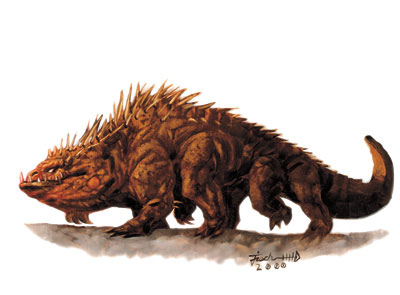
A basilisk's powers are truly terrifying. It is able to kill anything that meets its gaze including humans, animals, as well as plants. All other serpents will flee from the basilisk's hiss. Its touch is poisonous, killing all living thing it touches and in some cases, its poison can travel through a weapon to kill the wielder. Its very breath can wither vegetation. It is so venomous that it can actually crack and break any stone it comes in contact with. Wherever it goes, it leaves a path of poison and death.
In the oldest sources the basilisk's glance simply kills. The idea that it turns its victims to stone is mostly a modern addition, borrowed from the Gorgon Medusa and made popular by fantasy books and games.
The Basilisk in Ancient Writing
The classic description comes from the Roman writer Pliny the Elder, in Book 8 of his Natural History (first century AD). Pliny places the basilisk in Cyrenaica, in what is now eastern Libya. He describes it as a snake no more than twelve fingers long, marked with a white spot on its head like a diadem. Its hiss drives away all other snakes, it travels with the front of its body raised, it kills shrubs and scorches grass by touch and breath, and it splits rocks. Pliny also repeats a story of a horseman who speared a basilisk, only for the poison to run up the spear and kill both him and his horse.
The Roman poet Lucan, in his epic Pharsalia, gives a memorable scene from Cato's march across the Libyan desert. Snakes born from the blood of Medusa's severed head attack the soldiers, and one of them, Murrus, spears a basilisk. When the venom begins to climb the spear toward him, he cuts off his own arm to save his life.
Later writers kept passing these details along. In the 600s, Isidore of Seville's Etymologies, one of the most-copied books of the Middle Ages, called the basilisk the king of serpents and repeated that weasels could kill it.
The Weasel, the Basilisk's Natural Enemy
Pliny also gave the basilisk its one natural enemy. He wrote that people threw weasels into basilisk holes, and that the weasel's smell killed the basilisk, although the weasel died in the fight as well. Pliny presents this as nature providing a cure for every evil: even the most poisonous creature has a match.
Many historians think this idea may echo real animals. The mongoose of Africa and Asia, a weasel-like hunter, is famous for fighting cobras, and the cobra's raised hood and upright hunting posture fit the description of a snake that moves with its head held high. The ancient Greek name for the Egyptian mongoose, ichneumon, also turns up in old animal lore as a snake-killer.
Defeating a Basilisk
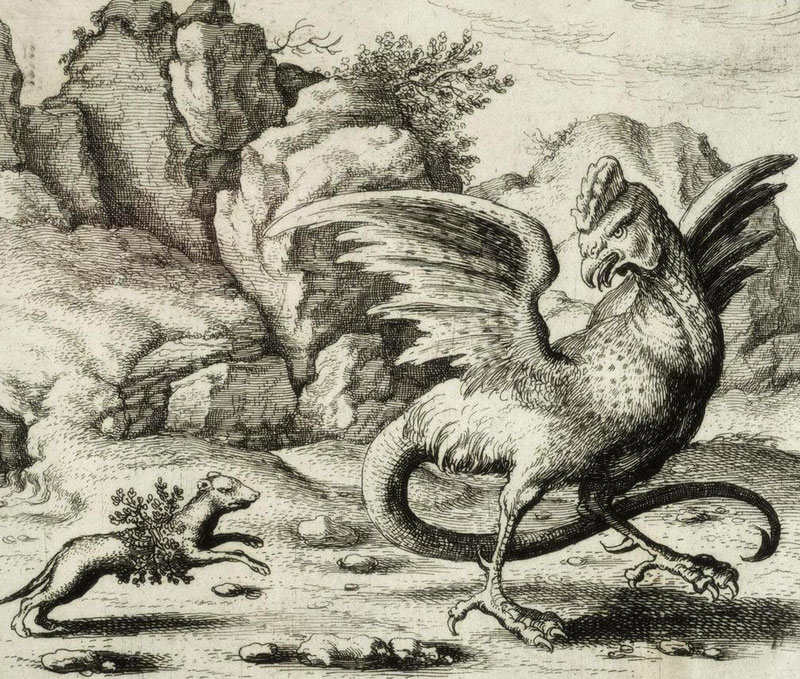
How to defeat this monster is as contended as how it is born. The most widely known way to defeat it is through the crow of a rooster. You must first locate the basilisk's burrow by following its trail or finding a concentrated area where the soil and plants have been affected by the creature's poison. When you find it, you must throw a rooster down the hole so when it crows the basilisk is sure to hear it and perish.
Another popular way of defeating this dreaded monster is by causing it to gaze upon its own reflection in a mirror. Some say that if a basilisk sees its own reflection it will drop dead of fright while others believe it will merely stun the creature. There is a legend from Warsaw of a man who was able to capture a basilisk with the help of mirrors. He went into a cellar where the bodies of two children were found, wearing a leather suit covered in mirrors and carrying a rake to catch the creature with. He was able to seize the monster with the rake and imprison it.
A lesser-known way of defeating the basilisk is with a weasel. It is believed that the weasel is immune to the basilisk's glance and poison. If you put a weasel into the basilisk's hole, the weasel will kill it with the stench of its urine but this will usually kill the weasel as well.
When a basilisk is killed, its body can be hung in a home to deter spiders and has been hung in temples to keep birds away. It is also thought that the ashes from a basilisk can be used in an alchemic formula to turn silver into gold. A medieval craft manual known as On Divers Arts, written under the name Theophilus Presbyter, even gives a recipe for "Spanish gold" that begins with breeding basilisks.
Basilisks in Medieval Bestiaries
Medieval bestiaries, the illustrated "books of beasts" popular in the 1100s and 1200s, gave the basilisk a place among the serpents. Their artists slowly turned Pliny's small crowned snake into something stranger. The crown spot became a crest or an actual crown, then a rooster's comb, and finally the basilisk took on a rooster's head, legs, and sometimes wings, with a serpent's tail. This is where the rooster-egg origin story fits in: a creature born from a cock's egg naturally looked part rooster.
Bestiaries also read animals as lessons. The basilisk often stood for sin or the Devil, a small thing that kills with a look. In the Latin Vulgate Bible, Psalm 91 (Psalm 90 in the Vulgate's numbering) promises that the faithful will tread on the asp and the basilisk, and medieval artists sometimes showed Christ standing on a basilisk and other beasts. See dragons in the Bible for related creatures.
Basilisk or Cockatrice?
The basilisk and the cockatrice have been confused for centuries, and many medieval and Renaissance writers used the two names for the same creature. The King James Bible, for example, uses "cockatrice" in several verses where earlier translations had a basilisk or a kind of viper.
In modern retellings the difference usually comes down to birth and looks. The basilisk is mostly serpent, hatched by a rooster from a serpent's or toad's egg. The cockatrice is mostly rooster with dragon wings and a snake's tail, hatched by a toad or serpent from a rooster's egg. English heraldry draws a further line: a heraldic basilisk looks like a cockatrice but has a second, dragon-like head at the end of its tail.
The basilisk is also related, in spirit, to dragons and to the wyvern, which heraldry draws with a very similar two-legged, winged body. See the full list of dragon species for more relatives.
The Basilisk of Basel
The Swiss city of Basel has used the basilisk as a symbol for centuries, partly because the names sound alike. Basilisks hold the city's coat of arms on fountains and buildings around the old town. Basel is also the setting of a much-retold account from 1474, in which a rooster was put on trial and burned for supposedly laying an egg, out of fear that the egg would hatch a basilisk.
Basilisks in Later Literature
By Shakespeare's time the basilisk's killing look was a common figure of speech. In Richard III, when Richard flatters Lady Anne about her eyes, she answers, "Would they were basilisks, to strike thee dead!" Shakespeare mentions the creature in several other plays as well, always for its deadly gaze.
The basilisk has stayed a favorite monster ever since. In J.K. Rowling's Harry Potter and the Chamber of Secrets (1998), a gigantic basilisk lives beneath Hogwarts. Its direct gaze kills, people who see it only indirectly are petrified, and spiders flee from it, all borrowed from old lore along with the rooster's crow being fatal to it. Basilisks also appear in Dungeons & Dragons and many video games, usually as many-legged reptiles with a petrifying gaze, a modern twist rather than a medieval one.
The name has even passed to a real animal. The basilisk lizards of Central and South America, genus Basiliscus, are named for the crests on their heads. They are harmless, and famous for running across water on their hind legs.
Frequently Asked Questions
What is a basilisk?
A legendary serpent, called the king of snakes, that could kill with its gaze, its breath, or its touch. It was first described by Roman writers such as Pliny the Elder and later became a rooster-headed monster in medieval bestiaries.
What kills a basilisk?
According to legend, a weasel, the crow of a rooster, or the sight of its own reflection in a mirror.
Is a basilisk the same as a cockatrice?
They were often treated as the same creature in older texts. Modern tellings usually separate them: the basilisk is mostly serpent and the cockatrice is mostly rooster.
Does a basilisk turn people to stone?
In ancient and medieval lore, its glance kills outright. Turning victims to stone is a later idea that became common in fantasy games and books.
Sources and Further Reading
- Pliny the Elder, Natural History, vol. 3, books 8–11, trans. H. Rackham (Loeb Classical Library 353, Harvard University Press, 1940).
- Lucan, Civil War (Pharsalia), trans. Susan H. Braund (Oxford University Press, 1992).
- Isidore of Seville, The Etymologies, trans. Stephen A. Barney, W. J. Lewis, J. A. Beach, and Oliver Berghof (Cambridge University Press, 2006).
- Theophilus, On Divers Arts, trans. John G. Hawthorne and Cyril Stanley Smith (University of Chicago Press, 1963; Dover, 1979).
- T. H. White, trans., The Book of Beasts: Being a Translation from a Latin Bestiary of the Twelfth Century (Jonathan Cape, 1954).
- Willene B. Clark, A Medieval Book of Beasts: The Second-Family Bestiary (Boydell Press, 2006).
- Laurence A. Breiner, "The Career of the Cockatrice," Isis 70, no. 1 (1979): 30–47.
- John Vinycomb, Fictitious and Symbolic Creatures in Art, with Special Reference to Their Use in British Heraldry (Chapman & Hall, 1906).